ARL GRAZER A – UAV
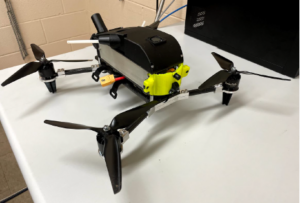
GRAZER A – UAV
Our center’s ARL Grazer A is a compact, agile unmanned aerial vehicle (UAV) integrated into our multi-robot TRACE testbed as the aerial component of our heterogeneous robotic platform ecosystem. With a gross takeoff weight of approximately 2.5 kg, the Grazer A is equipped with a Modal AI VOXL 2 onboard computer and mRo Control Zero H7 flight controller, enabling onboard perception, real-time inference, and autonomous flight behaviors. Its multi-camera payload — including a forward-facing 4K RGB camera, stereo cameras for forward and downward views, a downward-facing rangefinder, and an optional gimbaled camera — supports vision-aided navigation, depth estimation, and aerial data collection across our research scenarios. A Doodle Helix mesh radio enables reliable communication in multi-agent and GPS-denied environments. The platform conforms to NDAA 2020 requirements for DoD UAS, making it suitable for federally collaborative research. Operating the Grazer A at ARL and UMBC facilities requires close coordination between researchers and ARL for hardware, software, and safety pilot certifications, ensuring safe and reproducible experimentation. Together, this configuration makes the Grazer A a capable platform for aerial perception, multi-robot coordination, and edge autonomy research within the TRACE testbed.
Key Capabilities
- Aerial mobility with agile flight; supports indoor and outdoor operation in structured and GPS-denied environments
- Vision-aided perception: forward-facing 4K RGB and stereo cameras for obstacle avoidance, depth estimation, and visual odometry
- Multi-modal sensing: downward stereo camera and rangefinder for altitude hold, terrain following, and precise landing
- Onboard compute: Modal AI VOXL 2 for real-time inference, SLAM, and autonomy stack execution at the edge
- Mesh networking: Doodle Helix radio for resilient communication in multi-agent and contested RF environments
- NDAA 2020 compliant: approved for use in DoD-affiliated research programs
Hardware Configuration
Base Platform
- ARL Grazer A airframe; gross takeoff weight ~2.5 kg
Flight Controller
- mRo Control Zero H7
Onboard Computer
- Modal AI VOXL 2 — supports ROS 2-based autonomy, vision processing, and edge ML inference
Sensor Payload
- RGB Camera: One forward-facing 4K camera
- Stereo Camera: One forward-facing stereo pair
- Stereo Camera: One downward-facing stereo pair
- Rangefinder: One downward-facing
- Gimbaled Camera (optional payload)
Communications
- Radio: Doodle Helix mesh network radio
Autonomy Architecture
- ROS 2-based autonomy platform
- PX4-based flight controller running on Pixhawk-compatible hardware
- Supports vision-enabled/GPS-denied flight, onboard decision making, and air-ground multi-agent teaming
- Algorithms run onboard the vehicle for autonomous, non-teleoperated behaviors
Compliance & Procurement
- Conforms to National Defense Authorization Act (NDAA) 2020 requirements for DoD UAS
- Available for institutional purchase; coordinated through ARL and DoD procurement channels
Integration Notes for Multi-Robot Testbed
- Networking: Assign static IP/hostname on lab VLAN; document DHCP reservations for VOXL 2
- Time Sync: NTP/PTP time synchronization across all TRACE robots and logging PCs
- Data Pipeline: Define ROS 2 topics to record (RGB, stereo, IMU, rangefinder, state estimates); set storage and retention policies
- Interop: Bridge VOXL 2 ROS 2 nodes with ground robot stacks for air-ground teaming experiments
- Safety Interlocks: Shared E-stop policy, geofenced flight areas, and speed/altitude caps in multi-robot zones
- Calibration: Camera intrinsic/extrinsic calibration using shared calibration board; align coordinate frames with ground robot reference frames
- Versioning: Track VOXL 2 OS, PX4 firmware, ROS 2 stack versions, and autonomy algorithm versions